Service Area Page Strategy Without Doorway Pages for Phoenix Suburbs
A practical local SEO guide for home-service owners deciding which Phoenix suburbs deserve standalone service-area pages and what each page must prove.
What a useful service-area page should do
A service-area page should help a homeowner decide whether your company is the right fit for their location, service need, timing, and expectations. It is not just a page with a city name in the title. For a Buckeye HVAC company, a useful Buckeye page might explain which neighborhoods are commonly served, how quickly the team can respond, what seasonal issues show up in newer homes around Verrado, and what kind of maintenance or repair work the company handles most often.
The page should also help the business owner make a clear operational promise. If you serve Goodyear every day but only take emergency calls in Surprise during certain windows, the page should say that. If Avondale jobs often require different scheduling than far-west Buckeye routes, that belongs in the content. Useful local SEO is strongest when the website reflects how the company actually works.
Why copied city pages create weak SEO and weak trust
Google's spam policies describe doorway abuse as pages created to rank for similar searches instead of helping users. For home-service companies, the common version is a group of city pages where only the city name changes: plumber in Buckeye, plumber in Goodyear, plumber in Surprise, plumber in Avondale, and so on. Those pages usually do not help the customer choose because the proof, photos, reviews, service notes, and FAQs are identical.
Copied city pages also create a trust problem before a lead form is ever submitted. A homeowner can tell when a page was made for a search engine rather than for their situation. If the Glendale page says the same thing as the Peoria page, it does not answer whether the company knows older homes near downtown Glendale, HOA scheduling expectations in Peoria, summer response limits, or the neighborhoods where crews already work.
The safer strategy is simple: do not publish a standalone suburb page until you can make it meaningfully different. If the only unique detail is the city name, keep that area on a broader service-area overview until you have enough proof to support its own page.
The local proof that makes a suburb page worth publishing
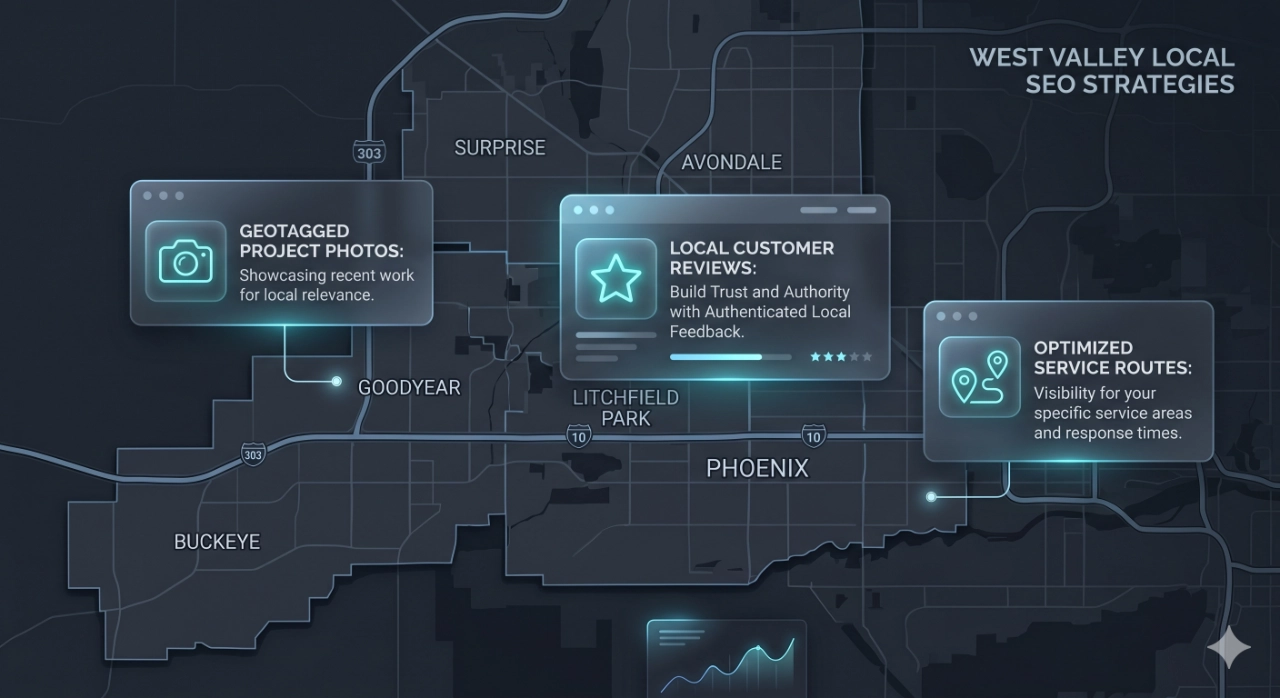
A strong service-area page gives specific proof that the company has context in that suburb. That proof can include recent job types, recurring service routes, neighborhoods, local photos, review snippets, crew availability, seasonal issues, and service constraints. A Goodyear page for a pool service company might mention weekly routes near Estrella, algae pressure after monsoon dust, and the difference between one-time cleanup calls and recurring maintenance. A Buckeye page for HVAC might talk about pre-summer tune-ups, newer subdivisions, and the need to schedule before the first major heat stretch.
Photos can help, but they should be real and relevant. A job photo from Verrado, a before-and-after from an Avondale water heater replacement, or a service truck parked at a completed Peoria job gives the page a reason to exist. Generic stock photos do not create the same local confidence.
Reviews also work better when they are matched to context. A page does not need to copy every review in full. It can summarize what customers in that area value: fast communication, clean work, emergency availability, recurring route reliability, or help with follow-up after the job.
Service constraints are content, not weaknesses
Many contractors avoid mentioning limits because they think every page should sound equally available everywhere. That creates vague content. In reality, service constraints often make a page more useful. A homeowner wants to know whether you serve their neighborhood, how soon you can arrive, what kinds of jobs you take, and whether there are travel fees, route days, minimum job sizes, or emergency limitations.
For example, a lawn care company might serve Buckeye and Goodyear on weekly routes but schedule Surprise and Peoria on specific days. A plumbing company might handle Avondale and Glendale emergency calls but prefer larger scheduled projects in farther suburbs. A garage door company might cover the whole West Valley, but with different same-day windows depending on technician location.
Clear constraints reduce bad-fit calls and make good-fit customers more confident. They also create natural differences between pages, which is exactly what thin doorway pages lack.
How to decide which suburbs deserve standalone pages
Start with business reality, not a keyword list. Make a list of the Phoenix-area suburbs you want to target, then score each one against four questions: do you already complete work there, can you show proof, is the area strategically important, and can you write something useful that is not copied from another page?
Buckeye, Verrado, Goodyear, Surprise, Avondale, Peoria, and Glendale might all be served areas, but that does not mean they all need pages on day one. If Buckeye and Goodyear account for most current jobs, those pages should probably come first. If Surprise is a growth target with only a few examples, build a stronger section on the service-area overview and collect proof before publishing a dedicated page. If Glendale is served but not a strategic focus, it may not need its own page yet.
A practical rule: publish a standalone page when you can include at least three local proof points, one clear service constraint or scheduling note, one customer question specific to that area, and at least one internal link that helps the reader take the next step.
A page structure that avoids duplicate city content
Use a repeatable structure, but do not reuse the same copy. A good service-area page can follow a consistent outline: who the page is for, services available in that area, proof from nearby jobs or routes, common seasonal issues, neighborhoods or local context, scheduling expectations, FAQs, reviews, and the next step. The structure can be the same because users need similar categories of information. The actual content should change because each suburb has different proof and constraints.
For a Verrado-focused page, the content may lean into newer homes, HOA expectations, seasonal HVAC preparation, and specific neighborhoods. A Glendale page may need different context around older housing stock, emergency repair calls, or mixed residential and commercial service needs. A Peoria page may emphasize route planning, recurring maintenance, and service windows across a larger geography.
The goal is not to make every page long. The goal is to make every page useful enough that a customer in that area would learn something they could not get from the generic service page.
How to link service-area pages into the rest of the site
Service-area pages should not sit alone. Link to them from the homepage when they represent priority markets, from core service pages when location affects the service, from blog posts when an example naturally fits, and from Google Business Profile updates when a local tip points to a relevant page. Keep those links crawlable with real href destinations so search engines and customers can follow the path.
The link context matters. A lead generation page might link to a Buckeye or Goodyear service-area example when discussing local conversion paths. A recurring services page might link to pages for suburbs with established maintenance routes. A blog post about service business automation in Phoenix can link to a service-area strategy article when the topic shifts from lead capture to website architecture.
Google Business Profile posts can also support the page without stuffing city names. Share a useful local SEO tip, mention the suburb context naturally, and use the native Learn more button to point to the article or the relevant service-area page. Keep phone numbers out of the post text and let the GBP CTA handle the action.
Quality checklist before publishing a service-area page
Before publishing, ask whether the page would still be useful if the city name were removed from the title. If the answer is no, the page is probably too thin. Add real local context or keep the content inside a broader service-area page until you have more proof.
Use this checklist: the page names the services available in that suburb, explains who the page is for, includes real local proof, mentions neighborhoods or route context where appropriate, clarifies response times or scheduling limits, answers at least one local FAQ, links to the relevant service or contact page, and avoids copying paragraphs from another city page.
The final test is whether the page helps both sides of the lead. The homeowner should understand whether you serve their area and what to do next. The business should attract better-fit inquiries instead of more vague calls. That is the difference between a useful service-area page and a doorway page built only for rankings.
RESOURCES
See how Buckeye GMB connects local SEO, content strategy, automation, and follow-up for home-service companies.
Connect useful service-area content to speed-to-lead workflows, qualification, and booked appointments.
Turn local service demand into repeat visits, reminders, maintenance plans, and review opportunities.
Pair local SEO architecture with practical automation for Phoenix-area service businesses.
Talk with Buckeye GMB about which suburbs, services, and proof points should shape your site architecture.
Build service-area pages around proof, not placeholders.
Buckeye GMB helps Phoenix and West Valley home-service companies decide which suburbs deserve standalone pages, what local evidence belongs on each page, and how those pages should connect to GBP, reviews, and lead follow-up.
Map Your Service Areas